The preparation is what keeps most people from scheduling a colonoscopy. But if you ask anyone who's been through it, they'll say the same thing: it wasn't nearly as bad as they expected. That gap between what people dread and what actually happens is the whole reason for this guide.
Adjusting Your Diet Before the Procedure
Most colonoscopy prep protocols begin a few days before the procedure. You'll typically be asked to avoid high-fiber foods — seeds, nuts, raw vegetables, whole grains, and popcorn — for two to three days beforehand. These foods are harder to fully clear from the colon and can obscure the view during the exam.
Think soft, low-fiber foods: eggs, white bread, chicken, white rice, fish, cooked vegetables without skins. Nothing dramatic. You're eating normally, just with some simple modifications.
Your GI Center will send you detailed prep instructions when you schedule your appointment. Read them the day you receive them — not the night before — and follow them as written. The quality of your colon preparation directly affects the quality of the colonoscopy.

The Bowel Prep — What Actually Happens
Here's where the reputation comes from. The day before your colonoscopy, you're on a clear liquid diet: water, broth, clear juices without pulp, plain popsicles, and black coffee or tea without dairy. This is also the day you take the bowel prep solution — a laxative that clears the colon completely before your procedure.
Prep solutions come in different forms. Some require drinking a larger volume spread over several hours. Others are lower-volume preparations that many patients find more tolerable. Your GI doctor in South Houston will prescribe the prep that fits your situation and health history.
What happens after you take it is exactly what you'd expect: your bowel empties completely. Plan to stay home. Stay near a bathroom. Keep light entertainment handy, drink plenty of clear fluids, and know that by the next morning — it's done.
"Most people who dread the prep say afterward that their anticipation was worse than the experience itself. The prep is inconvenient and messy. It's not painful."
One practical note: prep solutions can be easier to get down when chilled. Some patients mix them with a small amount of lemon or lime flavoring. Your prep instructions may include specific guidance on this.
Arriving at the Endoscopy Center
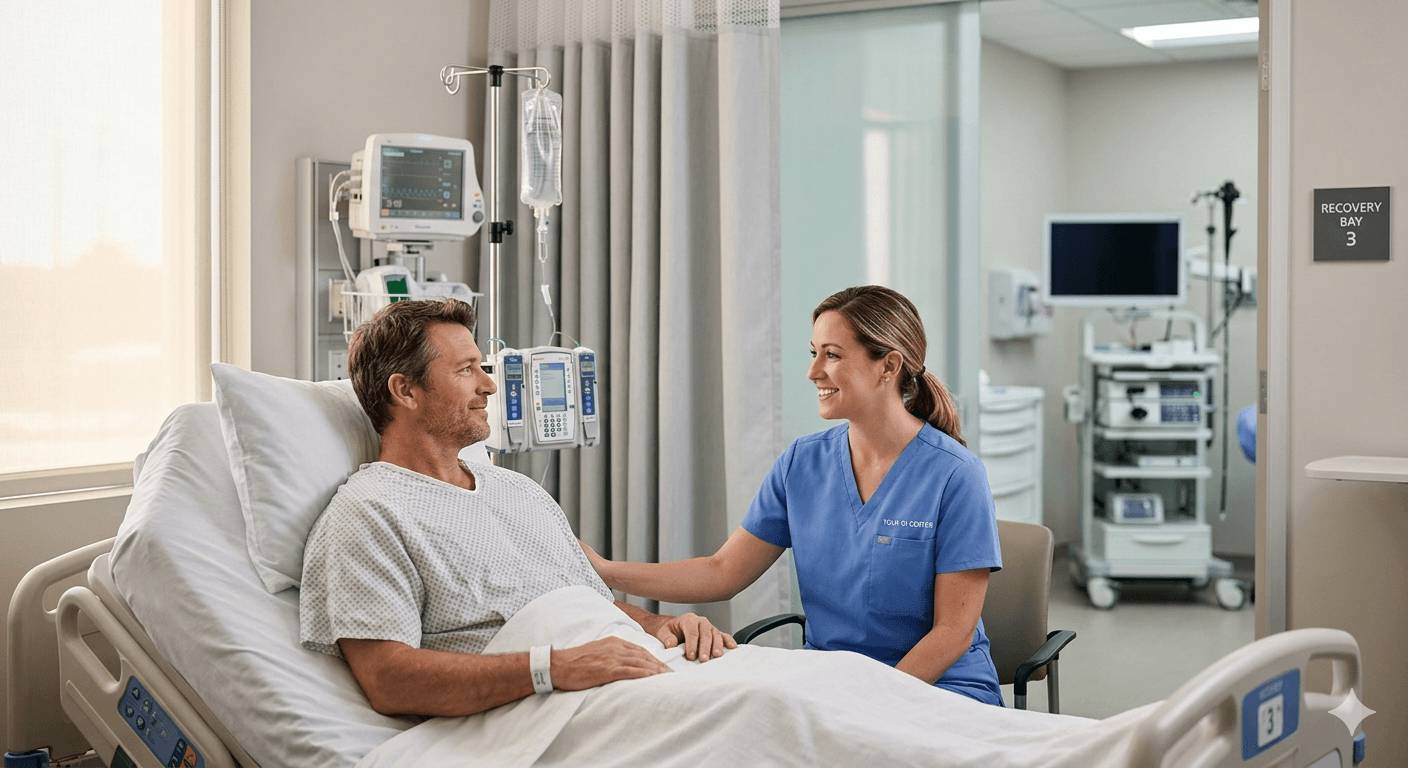
You'll arrive at the endoscopy center 30 to 60 minutes before the procedure. A nurse will review your medical history, current medications, and allergies. You'll change into a gown and get settled in a pre-procedure bay.
An IV line is placed in your arm — this is how sedation is delivered. Vital signs are checked, and when everything is ready, you're moved to the procedure room.
Most patients find that any nervousness fades once they're in the facility. The rooms are calm. The staff is unhurried. Many patients describe feeling relaxed well before the sedation begins.
What Happens During Your Colonoscopy
The sedation used for colonoscopy is typically a combination of a sedative and a pain reliever. You'll feel drowsy within a minute or two of the IV medication. Most patients are asleep — or very close to it — before the procedure begins.
You're positioned on your side on the procedure table. Sedation is given through your IV. Within minutes, you're fully relaxed and asleep.
Your gastroenterologist inserts the colonoscope — a thin, flexible tube with a tiny camera — through the rectum and carefully advances it through the full length of the colon.
As the scope is slowly withdrawn, your doctor examines the entire colon lining for polyps, inflammation, or other abnormalities. Air or CO₂ is used gently to improve visibility.
Any polyps found are removed immediately using small instruments through the scope — a polypectomy. Tissue biopsies are collected in the same pass if needed. You feel nothing.
The whole procedure takes 20 to 40 minutes for most patients. If polyps are found or if anatomy requires more careful navigation, it can take a bit longer. You won't remember any of it.

Waking Up & Going Home
Most patients wake up in the recovery area not knowing the procedure is over. Some remember nothing from the moment the IV medication started. Either way, you're awake, comfortable, and usually the first thing you ask for is something to eat.
You'll spend about 30 to 60 minutes in recovery while sedation clears and the nursing staff monitors your vitals. The most common sensation is mild bloating from the air used during the procedure — this passes within a few hours once you're home.
Before you leave, your gastroenterologist in Houston will speak with you directly about what was found, what was removed if anything, and what the next steps are. If you're still groggy — many people are — bring a family member or friend to hear this information as well.
You'll need someone to drive you home. Sedation impairs coordination and judgment for hours after the procedure — driving isn't allowed on procedure day regardless of how you feel.
Once home, rest and eat something light. Most people feel completely back to normal by the following morning. Many patients with desk jobs return to work the next day without difficulty.
Mild cramping and bloating are normal. If polyps were removed, minor spotting can occur — this is typical. Contact Your GI Center immediately if you experience significant abdominal pain, heavy bleeding, or fever above 100.4°F.

Contact Your GI Center immediately if you experience: significant abdominal pain or swelling, heavy rectal bleeding (more than a small amount), fever above 100.4°F, or inability to pass gas. These are rare but warrant prompt evaluation.
Things Patients Ask Us Before Their Colonoscopy
No. Clear liquids only until a few hours before your procedure time. Your instructions will specify the exact cutoff based on your scheduled time.
Contact your doctor's office. Depending on the situation, they may have you complete additional prep or, in some cases, reschedule. A partially prepped colon can reduce the effectiveness of the procedure.
The goal of sedation is that you won't. Occasionally patients feel brief mild pressure, but the vast majority report feeling nothing at all. Most don't remember anything from start to finish.
No. Even if you feel clear-headed, the sedation's effects on reaction time and judgment persist for several hours. The restriction applies regardless of how you feel — please arrange a driver in advance.
Ready to Schedule? Your GI Center Makes It Simple.
Our gastroenterologists, Dr. Nizam Meah and Dr. U. Siddiqui, perform colonoscopies at on-site endoscopy centers in South Houston, Lake Jackson, and Bay City. Our team walks you through every step — from prep instructions to your post-procedure follow-up. Have more questions? Visit our FAQ page. Appointment requests are typically returned within three hours during business hours.