
Crohn’s disease is one of the most frequently misdiagnosed conditions in gastroenterology. The average time from first symptom to accurate diagnosis is estimated at over two years in many patients — and some go far longer. That delay matters, because unmanaged Crohn’s disease doesn’t stay static. The inflammation progresses. Complications develop. Opportunities to reduce long-term damage narrow.
What Crohn’s Disease Is
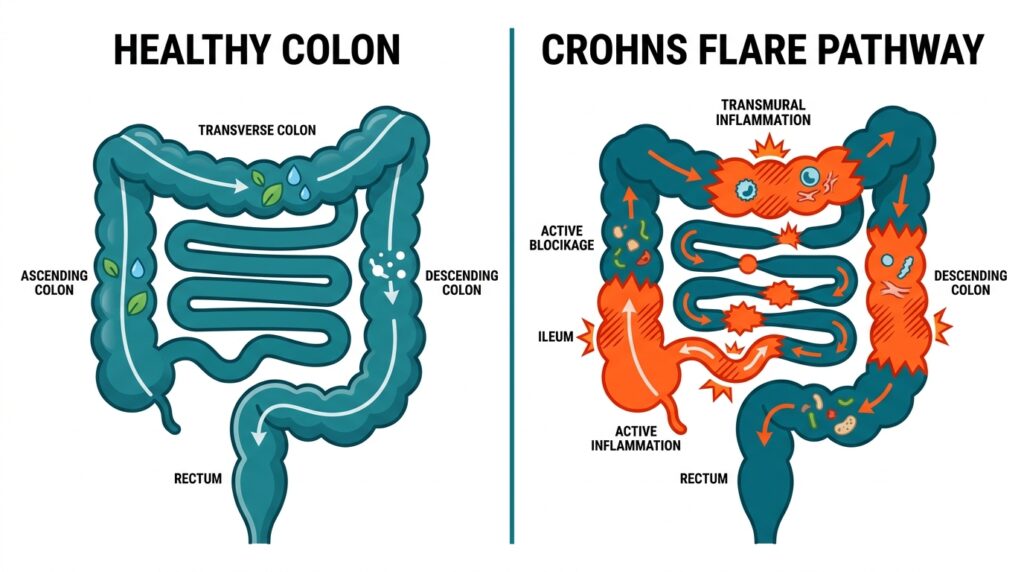
Crohn’s disease is a chronic inflammatory bowel disease (IBD) characterized by patchy, transmural inflammation — meaning the inflammation goes through all layers of the intestinal wall, not just the surface lining. This distinguishes it from ulcerative colitis, in which inflammation is continuous and confined to the inner lining of the colon.
Crohn’s can affect any segment of the GI tract from the mouth to the anus, but the most common location is the terminal ileum and the colon. The patchy, skip-lesion pattern of inflammation is characteristic and visible during colonoscopy. The transmural nature drives Crohn’s complications: fistulas, abscesses, and strictures.
Symptoms: Why Crohn’s Is Easy to Confuse with Other Conditions
Core symptoms include recurring abdominal pain (often crampy, frequently in the lower right abdomen), diarrhea (often loose, sometimes with blood), profound fatigue, unintentional weight loss, fever during flares, and bloating.
Extraintestinal manifestations — present in up to one-third of Crohn’s patients and a major cause of diagnostic delay: joint pain or swelling, skin manifestations (erythema nodosum, pyoderma gangrenosum), eye inflammation, liver conditions, and mouth sores.
The Most Common Misdiagnosis: IBS
Patients with Crohn’s disease are frequently told they have IBS — the symptoms overlap. But red flags distinguish them: rectal bleeding or blood mixed with stool, unintentional weight loss, symptoms that wake the patient from sleep, fever with GI symptoms, elevated inflammatory markers (CRP, ESR), iron-deficiency anemia, and extraintestinal manifestations. These findings don’t fit IBS — they suggest IBD until proven otherwise.
How Crohn’s Disease Is Diagnosed
Blood work typically reveals elevated inflammatory markers, anemia, and sometimes low albumin. Crohn’s-associated antibodies (ASCA) can support the diagnosis.
Stool studies include fecal calprotectin — highly sensitive for IBD versus IBS — and stool cultures to rule out infectious causes.
Colonoscopy with biopsy is essential. Colonoscopy visualizes characteristic skip lesions, deep ulcerations, and cobblestone-appearing mucosa. Biopsies provide histological confirmation, particularly the presence of granulomas, a hallmark finding in Crohn’s.
Cross-sectional imaging (CT enterography or MR enterography) evaluates the small bowel beyond colonoscopy’s reach.
Capsule endoscopy is used in selected cases when colonoscopy and imaging are inconclusive.
Why Getting the Right Diagnosis Matters

Modern biologic medications targeting specific inflammatory pathways have transformed outcomes for many Crohn’s patients. But biologics work best when started before significant bowel damage has occurred. Accurate, early diagnosis is what makes early treatment possible.
Management
Crohn’s is a chronic, lifelong condition — there’s no cure. The goal is achieving and maintaining remission, preventing complications, and protecting quality of life. Treatment includes aminosalicylates, corticosteroids (for flares, not long-term maintenance), immunomodulators, biologics (TNF inhibitors, anti-integrin agents, IL-12/23 inhibitors), newer small molecule oral agents, and surgery for complications or medically refractory disease.
Call 1-888-292-0010 — South Houston | Lake Jackson | Bay City