Most people show up to a new specialist appointment with a vague idea of what they want to accomplish and leave without half the answers they needed. It’s not because they didn’t care. It’s because walking into an unfamiliar medical setting, with a list of symptoms you’ve been living with for months, while trying to remember everything your primary care doctor said, while feeling nervous about what you might find out — is not a situation that naturally lends itself to organized thinking.
This is a guide for that situation. Five questions worth bringing with you to your first gastroenterology appointment at Your GI Center, with enough context to understand why each one matters.
Before the Questions: Come Prepared With This Information
Before covering what to ask, it helps to know what to bring: a clear timeline of your symptoms (specifics: when did this start, has it been constant or intermittent, is it getting worse, what makes it better or worse); a list of current medications including supplements with dosages; your relevant prior medical records (bloodwork from the past 12 months, any prior imaging, prior endoscopy reports); a first-degree family history relevant to GI conditions (colorectal cancer, IBD, celiac disease, polyps); and a note about previous tests and treatments.
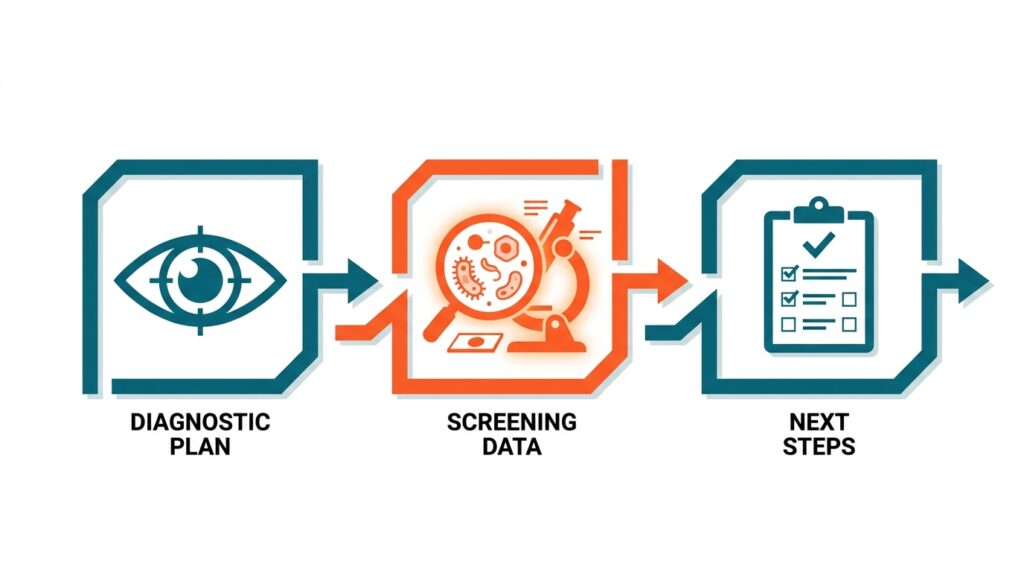
Question 1: “What do you think is causing my symptoms, and what’s your diagnostic plan?”
Your gastroenterologist should be able to tell you: here are the diagnoses we’re considering, here’s why, and here’s what we’re going to do to evaluate them. The “diagnostic plan” part is important because GI evaluations often unfold in stages. Understanding the logic of that sequence — rather than just following instructions — helps you engage with the process and flag anything that seems off.
If the doctor says something like “I think this might be IBS,” ask what leads them to that conclusion and whether any testing is being done to rule out other possibilities. A diagnosis of exclusion like IBS should be made after appropriate evaluation, not assumed.
Question 2: “Do I need a colonoscopy, and what will you be looking for?”
Colonoscopy comes up for two different reasons: as a screening tool (even when you feel fine) and as a diagnostic tool (when something needs to be evaluated). If you’re 45 or older and haven’t had a colonoscopy, the answer to “do I need one” is almost certainly yes. If you have a first-degree relative who had colorectal cancer or advanced polyps before age 60, the recommendation is typically to start screening at 40 or ten years before that family member’s diagnosis.
Understanding what your gastroenterologist is looking for helps you understand the results. Are we looking for polyps as part of routine screening? Are we evaluating for possible inflammatory bowel disease? The answer shapes what a “normal” result means and what the follow-up plan looks like.
Question 3: “Are there lifestyle or dietary changes I should make right now?”
Before prescriptions, before procedures, there’s often something practical and immediate you can do. Increasing fiber intake for constipation or diverticular disease, modifying fat intake for fatty liver disease or biliary issues, identifying trigger foods for IBS or GERD, starting a gluten-free diet if celiac disease is confirmed — ask what they’d recommend starting immediately, even before test results come back.
Question 4: “If you find something, what are the possible next steps?”
Understanding the range of possibilities ahead of time — rather than learning about them in the middle of a sedation recovery conversation — puts you in a much better position to process whatever comes next. If polyps are found during your colonoscopy, what happens? If upper endoscopy shows Barrett’s esophagus, what does that mean for ongoing monitoring? If blood work suggests celiac disease, what does the biopsy process look like? These scenarios have clear management pathways — knowing them ahead of time reduces the anxiety of the unexpected.
Question 5: “How and when will I hear back from you, and how do I reach your team between visits?”
After an endoscopic procedure, there may be immediate findings your gastroenterologist discusses with you in recovery — and there may be pathology results that come back three to seven days later. How will those results be communicated? Does the office call you? Is there a patient portal? Are you supposed to call at a specific time? And between appointments, how do you reach your care team if a symptom changes?

At Your GI Center, our team is reachable during business hours at 1-888-292-0010, and appointment requests during business hours are typically returned within three hours.
What You Should Feel Like Walking Out
At the end of a first GI appointment, you should leave knowing: what the doctor thinks is going on (or the leading possibilities), what testing has been ordered and why, whether a procedure is recommended and when, what you can start doing now, and how you’ll stay in contact. You deserve both time and specificity from a specialist.
Call 1-888-292-0010 — South Houston | Lake Jackson | Bay City