
There’s a particular kind of lower left abdominal pain that comes on without warning — steady, increasingly intense, and sometimes accompanied by fever. If you’ve experienced it, you might have assumed it was a pulled muscle, gas pain, or something you ate. Maybe you took ibuprofen and waited.
If that pain kept escalating, or if you’ve had recurring episodes of it, diverticulitis is very possibly the explanation. And it’s worth understanding, because diverticulitis ranges from manageable at home to a genuine medical emergency — and knowing which category you’re in matters.
What Diverticulosis Is (Before It Becomes Diverticulitis)
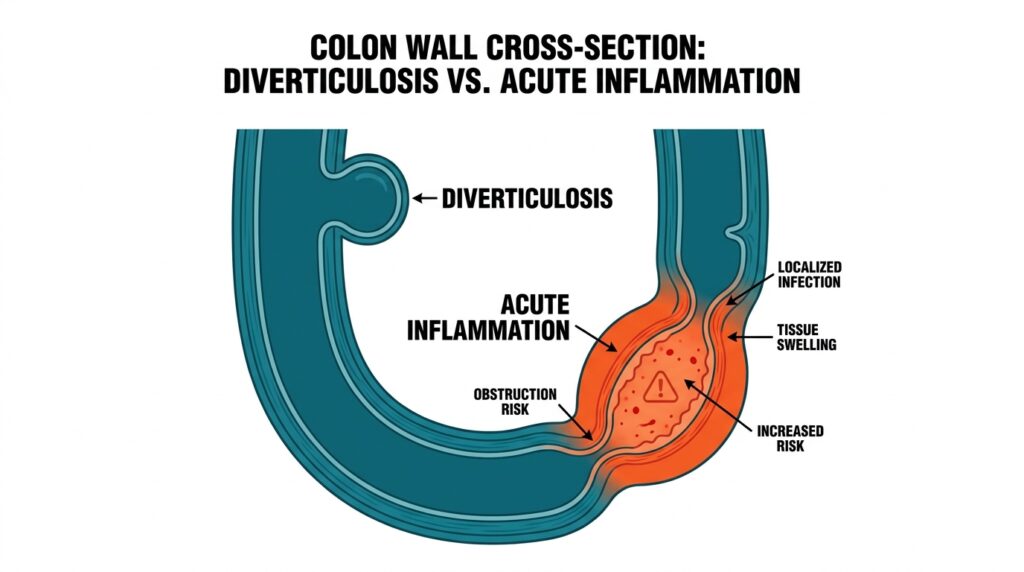
Diverticulosis is the presence of small pouches — diverticula — that form in the wall of the colon. By age 60, roughly half of all Americans have diverticula, and by age 80, the proportion may exceed 65 percent. Most people who have it never know. Diverticula are often found incidentally during a colonoscopy performed for colon cancer screening.
Diverticulitis is what happens when one or more of those pouches become inflamed or infected.
Recognizing Diverticulitis: The Classic Presentation
The classic presentation is a fairly steady pain in the lower left quadrant of the abdomen — where the sigmoid colon, where diverticula most commonly develop in Westerners, is located. The pain may start as mild cramping but typically intensifies over hours. Associated symptoms frequently include fever (low-grade to moderate), nausea, changes in bowel habits, and bloating.
Not everyone fits the classic pattern. In some patients, pain is less localized or even located in the lower right abdomen (right-sided diverticulitis can closely mimic appendicitis).
Severity: From Uncomplicated to Complicated Diverticulitis
Uncomplicated diverticulitis involves inflammation without significant complications — no abscess, perforation, or fistula. This is the most common presentation and can be managed as an outpatient with antibiotics and a liquid diet.
Complicated diverticulitis involves abscess formation, perforation (a surgical emergency), fistula, or obstruction. The distinction is typically made with a CT scan of the abdomen and pelvis.
When to Go to the ER vs. Call Your GI Doctor
Go to the ER if: your abdominal pain is severe and rapidly worsening, you have a rigid abdomen, fever above 101°F alongside significant pain, you can’t keep fluids down, or you have any signs of sepsis.
Call your GI doctor if: you have lower left abdominal pain and mild fever developing over hours, symptoms are concerning but not acutely severe, or you’ve had diverticulitis before and recognize this pattern.
Treatment for Uncomplicated Diverticulitis
Treatment typically includes antibiotics targeting colon bacteria (oral, seven to ten days), dietary modification during the acute phase (clear liquids advancing to low-fiber then normal), and acetaminophen for pain. NSAIDs should be avoided.
After an Acute Episode: The Role of Colonoscopy
After the episode resolves — typically four to six weeks later — colonoscopy is often recommended for patients who haven’t had one recently, had complicated diverticulitis, or had symptoms not entirely fitting the classic pattern.
Recurrent Diverticulitis and Long-Term Management
Recurrence occurs in roughly 20 to 35 percent of patients. For frequent recurrences, elective sigmoid colectomy may be discussed. Long-term prevention: high-fiber diet (25–35 grams daily), regular exercise, reducing red meat consumption, and avoiding NSAIDs.
Call 1-888-292-0010 — South Houston | Lake Jackson | Bay City