
Here’s something that catches most patients off guard: you don’t have to drink alcohol to have liver disease.
Non-alcoholic fatty liver disease — NAFLD — is now the most common liver condition in the United States, affecting an estimated one in four American adults. In Southeast Texas, where rates of obesity, type 2 diabetes, and metabolic syndrome run higher than national averages, the prevalence is likely higher still. And for the majority of people who have it, there are no symptoms at all — until the disease has progressed to a point where it’s significantly harder to reverse.
What NAFLD Is — and Why It Develops
NAFLD is the accumulation of fat in liver cells in people who drink little to no alcohol. The liver isn’t designed to store significant amounts of fat. When fat builds up beyond about five percent of the liver’s total weight, it impairs organ function and triggers an inflammatory response.
The overwhelming majority of NAFLD cases are driven by metabolic factors — specifically the cluster of conditions that travel together: excess body weight (particularly central/abdominal obesity), insulin resistance and type 2 diabetes, elevated triglycerides, and high blood pressure (metabolic syndrome).
Who is most at risk: adults who are overweight or obese, adults with type 2 diabetes or prediabetes, adults with metabolic syndrome, adults with elevated triglycerides or low HDL cholesterol, adults with hypertension, and adults over 45.
NAFLD vs. NASH: Understanding the Spectrum
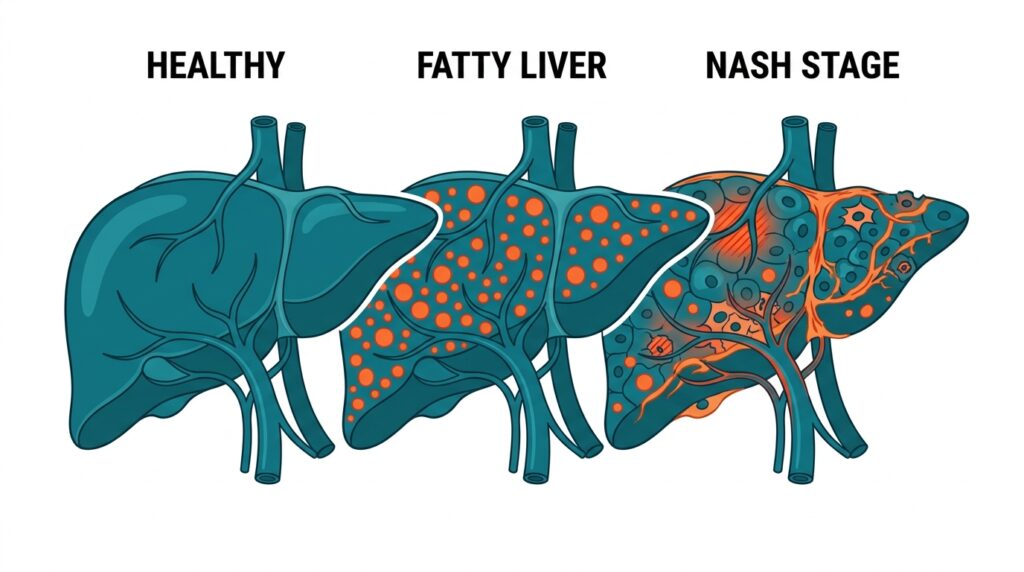
NAFLD exists on a spectrum. At one end is simple steatosis — fat accumulation without significant inflammation or cell damage. At the more serious end is non-alcoholic steatohepatitis (NASH) — inflammation and liver cell damage in addition to fat accumulation. NASH carries real long-term risk: it can progress to fibrosis (scar tissue), cirrhosis (extensive scarring), hepatocellular carcinoma, and liver failure.
Approximately 20 to 30 percent of patients with NAFLD have NASH. NASH cannot be distinguished from simple steatosis by symptoms, blood tests, or imaging alone. Liver biopsy is the definitive method for staging the degree of inflammation and fibrosis, though non-invasive scoring tools are increasingly used first.
Why NAFLD Is Often Discovered Incidentally
Most patients with NAFLD have no symptoms, particularly in early stages. The condition is frequently discovered incidentally: an elevated liver enzyme level (ALT or AST) on routine blood work, an ultrasound ordered for another reason showing a “bright” or echogenic liver, or a CT scan describing hepatic steatosis as an incidental finding.
The absence of symptoms doesn’t mean the condition isn’t present or isn’t progressing. It means the window for intervention — lifestyle changes and medical management — is still open.
How NAFLD Is Evaluated by a Gastroenterologist
Evaluation typically includes: detailed history and metabolic risk assessment (ruling out other causes of liver disease); blood work (liver function tests, lipid panel, fasting glucose and HbA1c, viral hepatitis serologies); abdominal ultrasound; non-invasive fibrosis assessment (FIB-4 score, NAFLD Fibrosis Score, or FibroScan where available); and liver biopsy when the degree of NASH and fibrosis needs to be established definitively.
Treatment: What Actually Works

Weight loss is the most effective treatment for NAFLD. A 5 to 7 percent reduction in body weight improves liver enzyme levels and reduces liver fat. A 7 to 10 percent weight loss improves histological NASH scores. Weight loss greater than 10 percent is associated with fibrosis regression in some patients.
A Mediterranean-style diet — rich in vegetables, fruits, whole grains, olive oil, fish, and legumes, with reduced red meat, processed foods, and added sugar — has the most evidence for NAFLD specifically. Regular moderate aerobic exercise and resistance training both improve liver fat independent of weight loss. Significant alcohol reduction or elimination is appropriate for patients with established NASH or significant fibrosis.
Resmetirom received FDA approval in 2024 for NASH with moderate to advanced fibrosis — a landmark development your gastroenterologist can discuss in the context of your specific situation.
Schedule Your Liver Evaluation at Your GI Center
If you have risk factors for NAFLD — excess weight, diabetes, metabolic syndrome, or elevated liver enzymes discovered on routine blood work — a gastroenterology evaluation provides a clear picture of your liver health and an actionable plan.
Call 1-888-292-0010 — South Houston | Lake Jackson | Bay City